
An enquiry arrives. Someone copies the details into another system. Someone else asks for an update. And somewhere between the CRM, the WhatsApp chats and the spreadsheet, the enquiry stalls — until you step in to keep it moving.
If you run a growing business, you may know that loop well. You have the tools. What you don’t have is a system: something that connects your people, tools and suppliers, and makes it clear who owns each outcome.
This guide covers why the gaps keep landing on you, what a connected business system actually looks like, three questions to ask before adding another tool, and a five-step way to fix it — using AI and automation where they earn their place, not everywhere.
Why more tools haven’t made the business easier
Each tool solves one job. A CRM holds contacts. A messaging app handles conversations. An accounts package sends invoices. A supplier looks after the website. Every part does its job well.
The trouble is the space between them. Information has to move from one tool to the next, and someone has to notice when it doesn’t. In most founder-led businesses, that someone is the founder.
This is what people mean by tool sprawl. The problem is rarely the number of tools. It is that nothing joins them, so each new tool adds a new gap — and the gaps land with you.
Signs you’ve become the integration layer
- You copy the same details into more than one system.
- Updates arrive because someone asked, not because the system told them.
- Enquiries go quiet between the first reply and the follow-up, and nobody notices until the customer does.
- Your suppliers each own a piece of the work, but nobody owns the outcome.
- Reporting means exporting from three places into a spreadsheet.
- Time off feels risky, because when you step away, work stops moving.
If three or more of these sound familiar, the problem isn’t effort. It’s architecture.
What connected business workflow automation looks like
The goal is one connected system with clear ownership. Information flows between your tools without anyone retyping it. Each hand-off has a trigger and a named owner. And you can see where every piece of work is without asking.
It helps to think of it in four layers:
| Layer | What it does | Example |
|---|---|---|
| Data | One reliable record of each customer, enquiry and order | An enquiry is captured once and visible everywhere it’s needed |
| Automation | Moves information and triggers the next step | A new enquiry creates a CRM record and sends a WhatsApp acknowledgement |
| AI | Takes on repetitive work that needs some judgment, with a person on the decisions that matter | Drafting a first reply, summarising a long thread, sorting enquiries by type |
| Ownership | A named person or role for each outcome | Who follows up, by when, and what happens if they don’t |
AI and automation are how the work gets done. Data is what they run on. Ownership is what makes it last — without it, even well-built automation drifts back into chasing.
What it looks like in practice
CRM automation is often where this starts, because the lead journey is where the gaps cost the most. One business owner described the change like this:
“Parag did more than automate our CRM. He took ownership of the full lead journey and turned a manual, fragmented process into a connected system that gives our team greater visibility, consistency, and confidence from enquiry to closure.”
The important words there are “took ownership of the full lead journey”. The automation mattered. The ownership is what made it work.
Before you add another tool, ask three questions
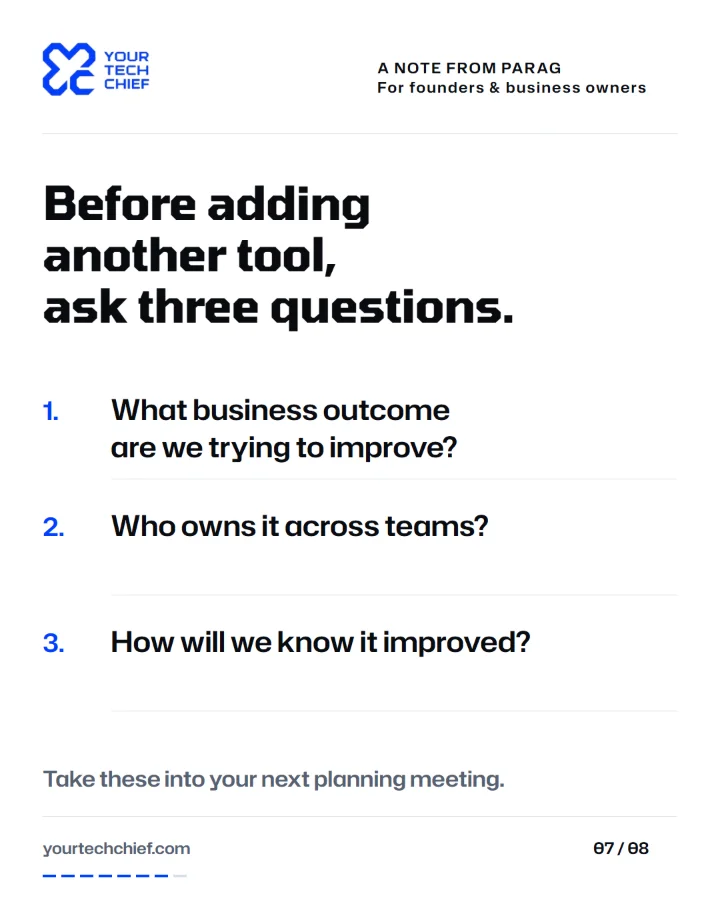
When something isn’t working, the natural reaction is to look for a new tool. Before you do, answer these three questions.
- What business outcome are we trying to improve? Name the outcome, not the tool. “Reply to every enquiry within an hour” is an outcome. “We need a new CRM” is a guess about a solution.
- Who owns it across teams? Most broken workflows cross more than one team or supplier. If nobody owns the outcome end to end, a new tool will be adopted by some people, ignored by others, and quietly abandoned.
- How will we know it improved? Pick a number you can check before and after: response time, conversion rate, or the hours someone spends chasing each week. If you can’t measure it, you can’t tell whether the tool helped.
Take these into your next planning meeting. If you can’t answer all three, a new tool is more likely to add a gap than close one.
How to connect your tools without starting again: five steps
Connecting a business rarely means replacing everything. Most of the time the tools are fine; what is missing is the connections between them and the ownership of each hand-off. This is the five-step approach YTC uses:
- Diagnose. Understand the business and where work gets stuck. Map how an enquiry, order or job actually moves today, including the workarounds nobody wrote down.
- Align. Agree on the outcome and priorities with the people involved, so founders, teams and suppliers are solving the same problem.
- Architect. Design the systems, connections and responsibilities. Choose the smallest coherent system that works, and reuse what you already have before buying more.
- Execute. Lead delivery across teams and suppliers, so what gets built matches the design and every hand-off lands.
- Review. Measure what changed and improve what comes next. Automation that nobody measures drifts.
You can read more about how this approach works and the services behind it, including CRM and lead lifecycle automation and AI product delivery.
Where a fractional CTO fits
A fractional CTO gives a business senior technology leadership part-time, without a full-time hire. For connected systems that matters, because the problem sits between tools and suppliers. An agency builds what it is asked to build. A software vendor sells its own tool. Someone has to own the whole.
That is the role Your Tech Chief takes. I’m Parag Bhadoria, and YTC is my fractional CTO practice, built on 10+ years of technology leadership across the UK and India. For 3+ years, YTC has worked with businesses through a closed network. Now I’m opening that support to more founders and business owners. You can see the results that work has produced.
Questions founders ask about workflow automation
What is business workflow automation?
Business workflow automation uses software to move information and trigger the next step between the tools a business already uses. Enquiries, follow-ups, payments and updates then happen on their own, and people spend their time on the judgment rather than the copying.
Do I need to replace my existing tools?
Usually not. Most gaps come from how tools are connected and who owns the hand-offs, not from the tools themselves. Start by mapping how work moves today, and replace a tool only when it cannot do what the outcome needs.
Is AI automation right for a small business?
Where the work is repetitive but needs some judgment, such as drafting replies, summarising threads or sorting enquiries, yes, with a person confirming anything that cannot be undone. Where a simple rule will do, a rule is cheaper and more reliable than AI.
What does a fractional CTO do in an automation project?
A fractional CTO owns the outcome end to end: diagnosing where work gets stuck, designing the connected system, leading delivery across your team and suppliers, and measuring what changed afterwards.
How much does it cost to work with YTC?
It depends on the scope of the work, so there is no fixed price list. The first step is a free 30-minute call, where Parag understands your exact requirement. The cost is then set out for that scope, before you commit to anything.