
“Can we add AI to this?” It’s the most common technology request I hear from business owners right now. It sounds like an instruction. It isn’t. “Add AI” is a request, and your team still needs a brief: what the AI is for, what it needs, what it may do on its own, and how anyone will know it works.
Without those answers, a developer or agency will fill the gaps with guesses. You get a demo that impresses in a meeting and then quietly stops being used.
Why “add AI” isn’t an AI implementation plan
Most AI projects in small businesses don’t fail because the model is weak. They fail because nobody decided what the AI was for. The model is the easy part. The hard part is everything around it: the outcome, the information, the limits and the checks.
An AI implementation plan for a small business doesn’t need to be a long document. It needs five answers. Each one is a decision only the business can make, which is why it shouldn’t be left to whoever happens to be building it.
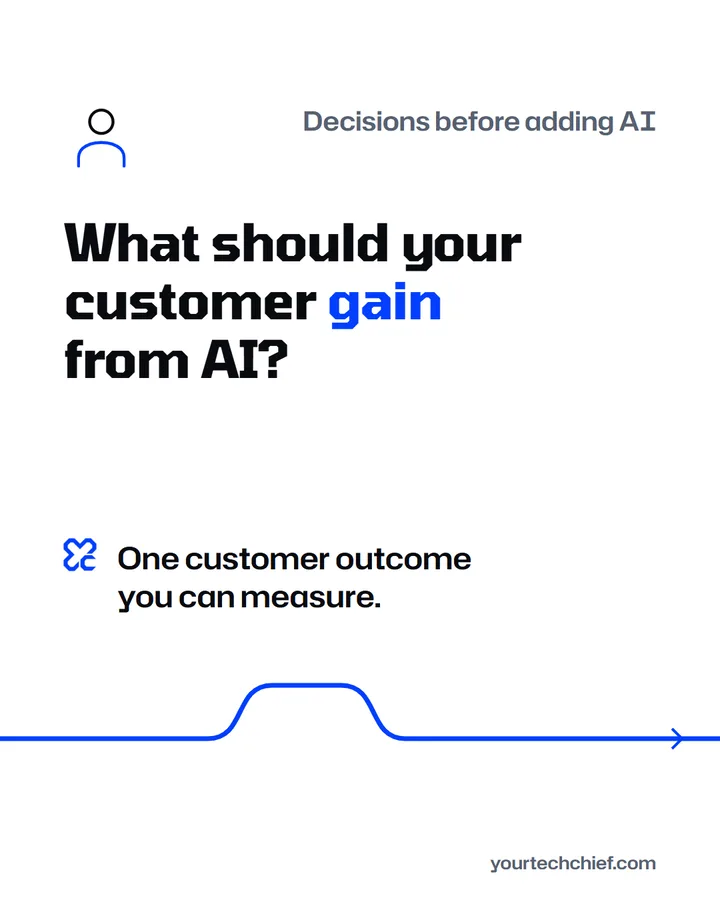
1. What should your customer gain from AI?
Pick one customer outcome you can measure. Not “use AI in sales” or “be more efficient”, but a change a customer would notice and you can count before and after.
| Vague request | Measurable customer outcome |
|---|---|
| “Use AI for enquiries” | Every enquiry gets a useful first reply within one working hour |
| “AI for quotes” | Quotes go out the same day the details are complete |
| “An AI chatbot on the website” | Customers get correct answers to the ten most common questions without waiting for staff |
| “AI for reporting” | The weekly sales report is ready on Monday morning, not Wednesday |
One outcome keeps the first version small enough to finish. It also tells you later whether the AI earned its place. That’s the difference between the strongest AI use cases for small businesses and an expensive experiment.
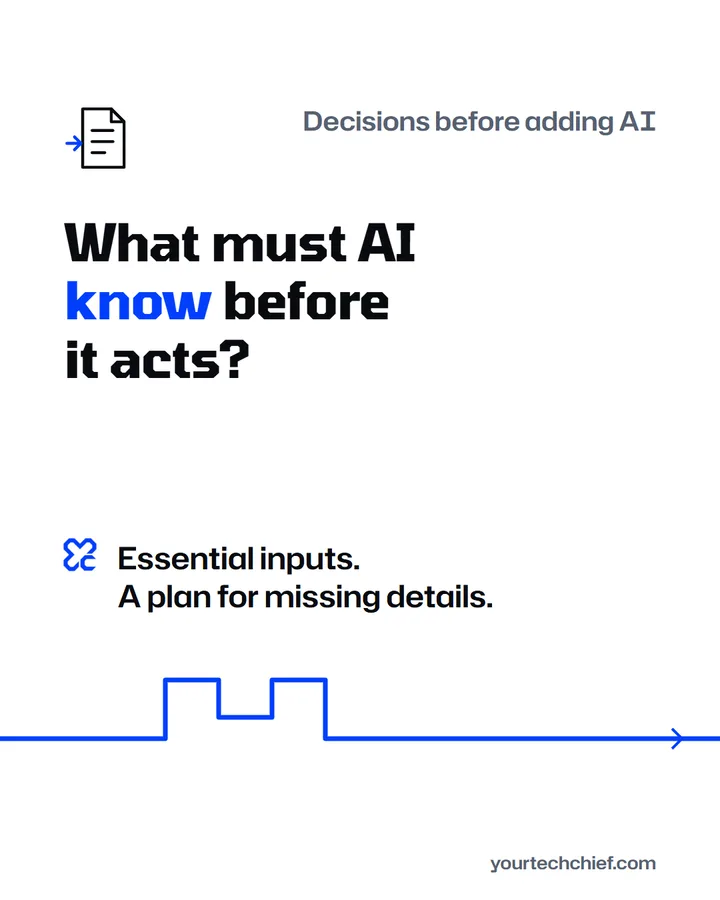
2. What must AI know before it acts?
List the essential inputs, and decide what happens when one is missing. AI can only work with the information it is given. If a quote depends on the number of users, the locations and the start date, those three fields are the inputs. Everything else is nice to have.
The second half matters more: a plan for missing details. When an input is missing, the AI should flag it and ask, not guess. A confident guess in a quote or a customer reply costs more than a short delay. In the enquiry-to-quote example, AI turns a free-text enquiry into a brief and lists what’s missing. It doesn’t invent the answer.
This is the part of an AI requirements document most teams skip, and the part that decides whether the AI is useful on real data or only on the clean examples in a demo.
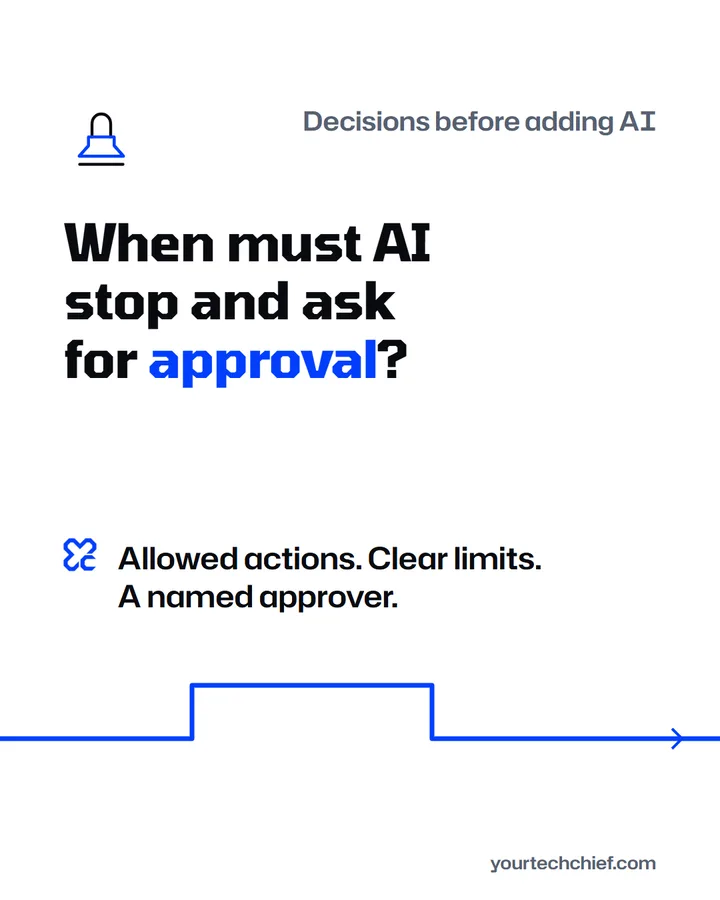
3. When must AI stop and ask for approval?
Write down the allowed actions, the clear limits and a named approver. This is what people mean by keeping a human in the loop: AI does the preparation, and a named person approves anything that commits the business.
| Action | AI may do it alone | Needs approval |
|---|---|---|
| Summarise an enquiry | Yes | No |
| Draft a reply or a quote | Yes, as a draft | Before it is sent |
| Send a price, a date or a promise | No | Always, by the named approver |
| Change a customer record or a payment | No | Always |
“A named approver” means a person, not “the team”. An AI approval process with no named owner turns into one where nobody checks. Write the limit in plain words: “AI may draft quotes up to any value; only the account owner sends them.”
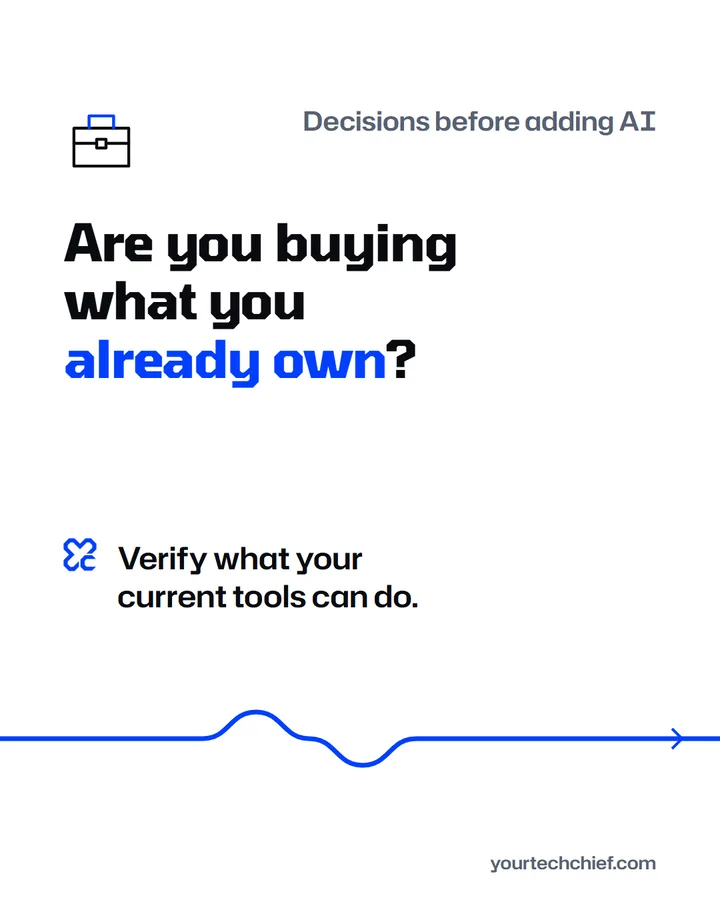
4. Are you buying what you already own?
Check what your current tools can do before you pay for a new one. Many CRMs, helpdesks, office suites and messaging platforms now include AI features, or connect to AI through features you already pay for. A business can end up buying a separate AI tool to do something its CRM could do with an afternoon of configuration.
Before buying, ask three questions about each tool you already use:
- Does it already have an AI or automation feature for this step?
- Can it connect to the tool that holds the inputs from decision 2?
- Who on the team owns it, and could they switch the feature on?
Sometimes the answer is still to build or buy. But it should be a decision, not a default. The same thinking applies beyond AI: see three questions to ask before adding another tool.
5. What must AI prove before you rely on it?
Test it on normal, missing and exceptional inputs before customers see it. This is how to test AI in a small business without a testing team: collect real examples from your own records and check the output against what a good person would have done.
- Normal inputs: ten or twenty typical cases. Does it get them right?
- Missing inputs: cases with a detail left out. Does it ask, or does it guess?
- Exceptional inputs: the odd ones, such as a complaint, a request in another language, or a very large order. Does it stop and hand over?
Agree the pass mark before testing, not after. Then cost it per result: what one usable answer costs, including the time someone spends reviewing it. When I built an AI that scores a charity on ten dimensions, every score came with its sources and a confidence level, a person could override it, and each evaluation was costed: about 3 minutes and about 40p. That’s what “proved before relied on” looks like.
The one-page AI project brief
Put the five decisions together and you have an AI implementation checklist and a brief in one. Copy this into a document, fill one row per decision, and give it to whoever is building.
| Decision | Write down | Example (enquiry to quote) |
|---|---|---|
| 1. Customer outcome | One change a customer notices, and how you’ll measure it | Quotes sent the same day details are complete |
| 2. Essential inputs | The facts AI needs, where they come from, and what happens if one is missing | Number of users, locations, start date; if missing, AI lists the questions to ask |
| 3. Approval boundaries | What AI may do alone, its limits, and the named approver | AI drafts; the account owner approves every quote before it is sent |
| 4. Existing capability | What current tools already do, and what is genuinely new | The CRM assigns the enquiry; only the drafting step is new |
| 5. Acceptance checks | The normal, missing and exceptional cases it must pass, and the pass mark | 20 past enquiries, 5 with missing details, 3 unusual ones; a person agrees with every draft before launch |
If you can’t fill a row, that’s the next conversation to have, before any code is written. The same page works as an AI readiness checklist: five complete rows mean you’re ready to build; gaps mean you’re not, yet.
Want a second pair of eyes on yours? Bring it to a free 30-minute review, and within a few hours you get a written list of what to fix first.
The answer might not be AI
Working through the five decisions often changes the plan. The next step may be AI. It may also be better information, clearer rules, or configuring a tool you already own. A rule that assigns every enquiry to an owner is cheaper and more predictable than AI. A missing field on a form is a data problem, not an AI problem.
That’s the point of deciding first. You spend on AI where it genuinely helps, and leave the rest alone. For how to tell the difference step by step, read AI, automation or a person: how to decide what to automate.
AI implementation consultant or fractional CTO?
An AI implementation consultant or agency usually starts from the build: a tool, a model, a delivery plan. A fractional CTO starts one step earlier, with the five decisions above, and stays accountable for whether the result works in your business, alongside your existing team and tools.
That is the role Your Tech Chief takes. I’m Parag Bhadoria, a fractional CTO for founder-led businesses in the UK and India, with 10+ years of leading technology, including AI products costed per result. You can see the situations founders bring and what changed for six businesses.
Questions business owners ask about implementing AI
How do I implement AI in a small business?
Start with five decisions before anyone builds: one measurable customer outcome, the inputs AI needs and what happens when they are missing, where AI must stop for human approval, what your existing tools can already do, and the tests AI must pass. Write them on one page and give that brief to your team or supplier.
What should an AI implementation plan include?
For a small business, five things: the customer outcome and how it will be measured, the essential inputs, the approval boundaries and named approver, what current tools already provide, and the acceptance checks with a pass mark agreed before testing.
What does human in the loop mean in AI?
It means AI prepares the work and a named person approves anything that commits the business, such as a price, a date, a promise to a customer or a change to a record. The AI can draft; the person decides before it reaches the customer.
How do I test AI before using it with customers?
Use real examples from your own records: typical cases, cases with a detail missing, and unusual cases. Check whether it gets the typical ones right, asks rather than guesses when something is missing, and hands over the unusual ones. Agree the pass mark before you start.
Do I need an AI consultant or a fractional CTO?
If the decisions are already made and you need something built, an AI implementation consultant or agency can deliver it. If the decisions keep coming back to you, or you are unsure AI is the right answer, a fractional CTO helps make those decisions and stays accountable for the result.